
What Women Actually Want from Trail Running Brands
This is part 8 of 8 of my summer series on community in trail running. See the whole series here.
In 2025, we surveyed 60 women in the Wild Woman Trail Runs community about their running habits, barriers, and preferences. The results popped up to remind me that hey, I’m sitting on a small goldmine of data about women in running! Yes, the sample size is small, but the respondents are enthusiastic and detailed. When I parsed it out, here’s what stood out to me.
👟 Wearing your brand vs. trusting your brand are different.
We asked two separate questions: What are your top three favorite running shoe or apparel brands? Then: what brands and companies do you think help women access running the most?
I would’ve expected some overlap in answers — but they didn’t correlate! Check out the columns:
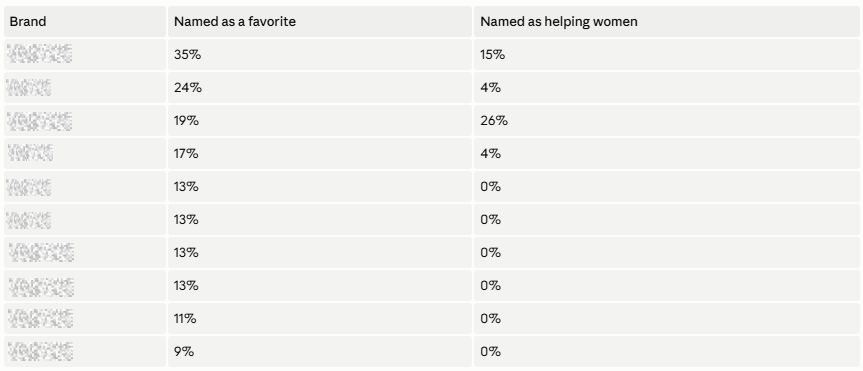
A third of respondents couldn’t name a single brand that helps women access running.
Write-in responses said: “not sure,” “no clue,” “I can’t think of any.” (The exception that did get shouted out, and by a notable quarter of respondents, was Oiselle!)
For the data nerds, I looked at these responses across demographics and found that the “can’t think of brands that help women access running” answer was even across age and income brackets. Less of a segment problem, more of a market problem, it seems?
The alarming part of this: Countless brands are preaching “inclusion! welcoming beginners! building community!” as their values. Clearly, that’s not reaching the end user. (I wrote about this more a few weeks ago: The Problem with “Inclusion”.) I’m more and more often getting the Ick from brands slapping words on their branding that they can’t stand behind.
Discussion starters:
Brands: There’s a discrepancy between how many people wear a brand vs. how many people believe the brand is there to welcome people like them. How can you narrow your ratio?
Individuals: What would a brand have to DO to prove that they care about your community? (Really, tell me, so I can rally with you.)
🏃🏽♀️➡️ Women runners are preoccupied with safety, and a product can’t solve the cause.
We asked: “What frustrates you most about being a woman in trail running?” 37% named fear as it relates to safety: they wrote about being watched, being followed, the need to carry a weapon, risks of running solo, hypervigilance near men on trail, having to tell a partner about their daily run plans, etc.
Safety was named more often than any other single frustration, by a wide margin.
As one respondent said: “What frustrates me most is that I feel safe until others make me feel unsafe.”
Other responses: no childcare at races, cutoff times too fast for a range of paces, coverage of the sport centered on men, gear designed for men.
Product innovation cannot solve the problem of women’s safety on trail. (Especially BIWOC, queer women, etc. — more on that in last week’s post.) And that’s probably why this problem persists over decades. If a product could solve the safety problem, we would’ve fixed it by now. Instead, we need brands to support the harder work of cultural shifts.
Nearly every brand in trail running sells the feeling of freedom in nature. Yet, many consumers buying from these brands are managing a constant calculation about their own safety the entire time — decidedly not freedom.
Discussion starters:
Brands: What can you offer beyond a product to advocate for women’s safety?
Individuals: What conversations do you wish men would have around being allies to women on trail?
💬 Trust travels through word of mouth recommendations.
We asked where respondents look for running guidance and inspiration. Over 3/4 of them said “friends.” Half mentioned podcasts, and (surprising to me), 40% said Instagram. Far and away, word-of-mouth is the go-to source. Love that for us.
I compared this to our 2026 post-race runner survey at Wild Woman, with 86 respondents (20% of registrants). Only 3% mentioned Instagram as how they discovered our race. 33% were returning runners, and 37% heard of us from a friend or running partner. Two relay teams formed because strangers met racers while vacationing in the area. We literally got more registrants from random people bumping into each other on trail than we did from social media.
You only get one shot at a race to earn a new registrant’s trust. Knowing that we spend nothing on advertising and that word of mouth recs steer the whole ship, it’s so important for Wild Woman to give runners an experience they’ll rave about.
And we did! 77% of 2026 post-race respondents rated us a flat 10/10 overall. 79% are already saying they're returning next year, 78% felt "very welcomed," 55% made a new connection, 78% camped on site. How I read this:
Many brands, races, and media are buying attention in a category where trust doesn’t transfer through attention. Trust transfers through people.
Here’s where I wanna dig deeper in the future: 56% of the 2025 survey respondents said they belong to no running community at all (run clubs, e.g.). But when asked about why they love Wild Woman, the aspect they name most often is “community.”
People are moving into the sport and events because of trusted friends and community — yet many women don’t have an ongoing community to spend time with. (For many, it’s one weekend a year at Wild Woman.) Hmmmmmm. This will be one to pocket for a future survey.
Discussion starters:
Brands: How are you reaching women customers who don’t belong to a running club or community?
Individuals: What’s keeping you from joining a run club?
📰 Representation in media can directly shift the demographics of the sport.
Okay, one more set of data I’ll bring up for this one. You’ve hopefully heard by now about the First 50k Sisterhood scholarship program I launched through The Cairn Project this year. (And we’re gonna expand it for next year!!!)
11 women from the first selected cohort completed an in-depth post-program survey. 8 said they did not see themselves represented in this sport before the program. 5 chose “Not at all, this was transformative for representation.” Only 1 said she already felt she belonged in trail running.
A whopping 100% said they would not have confidently attempted a 50k on their own this year without this program. After the program, 82% plan to run another ultramarathon in the next two years (zero said they wouldn’t).
When I opened applications to the Sisterhood in December 2025 for women who had never before run an ultra, 2/3 of applicants told us trail running industry representation was a barrier for them. Based on the data I have, I’d say that plenty of those women would run an ultra on their own if directly and authentically invited into the sport.
I’m a 33 year old, white, middle class, cis-het woman who wears standard sized clothing and has no known disabilities. In many ways, I’m the everyday runner that media caters to.
I’ve been aware for years that that is a problem; that bodies like mine are not representative of all women nor all runners. But I haven’t taken enough action to change this culture.
Over the past year, I’ve gotten to meet and build relationships with so many women runners who think and look differently from me. And now I’m more fired up than ever about banding together to help more and more of them access this sport.
The First 50k Sisterhood was an incredible first step towards shifting resources and representation towards the amazing humans and runners who we have largely ignored or actively harmed for decades (well, centuries, but decades since running went mainstream). And its data proves that when women find themselves represented in a community, they participate at a highly engaged level in the sport.
(Side note: My recent “WTF” musings are around age. I know tons of women runners in their 50s + 60s, but hardly ever see them in brand media. One of our First 50k Sisterhood runners is almost 70 and she was an incredibly strong and supportive community member. I’m going to be paying more attention to ageism in running.)
Discussion starters:
Brands: What are you doing to reach underserved and undercelebrated communities beyond telling your photographers to capture “diversity”?
Individuals: What publications or accounts do you follow that share a true breadth of runner stories?
My biggest takeaway from all the data I shared:
A product doesn’t inherently welcome anyone into trail running. It’s the community built around the product that can, and most brands are leaving a lot on the table.
Past posts from the series here.
And now, to leave on a beautiful high note, here are some direct quotes from Wild Woman 2026 runners for some feel good fuzzies: 😍
“No one cared how fast I was, they cared that I was out there. Whether it was conversations at camp, encouragement on the course, or cheering at the finish, I felt supported instead of judged.”
“I didn’t realize I needed an all woman event until I got to run in one.”
“I’m not here for my partner who ran the race. I’m not here for my friend who ran the race. I’m here because I ran the race - this is for me! I have NEVER been a competitor before.”
“In two of my three past races I had negative experiences with men, including being pushed out of the way. It nearly turned me off of events all together, until I found Wild Woman. I honestly feel like I have the courage to take on another event and take up the space I need after completing this 50k.”
"A woman congratulated me for being there and acknowledged that it takes a lot to train for a half with two children. I about cried. As a stay at home mom recognition and celebration aren't a part of my day to day."
“As a transgender runner, I think that might be the first time I’ve really felt like I belonged at an event I was running in.”
“As a recent 2x breast cancer survivor I used this training cycle to finally regain stamina to run a 6 mile relay leg. Being able to do so in such a supportive environment was a gift.”
“I am very happy I took the risk of trying this out at age 65, and have already signed up for my next ultra run in October!”